
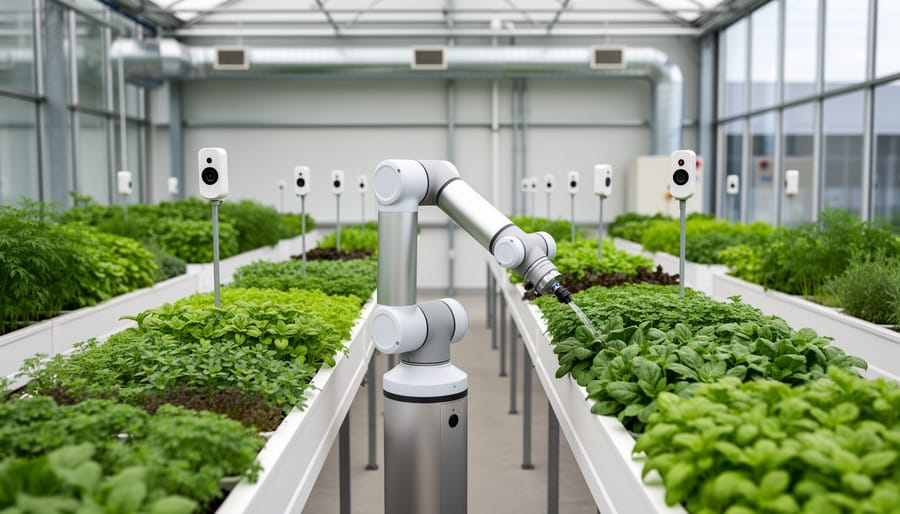
A robotic farm is a growing space where machines handle some or all of the repetitive work of raising plants: watering, feeding, lighting, monitoring, and often harvesting. Sensors collect data, software makes a decision, and robotic hardware carries it out, so crops get what they need without someone checking every tray by hand.
Why does that matter in a city? Because urban growers rarely have the luxury of open acreage. They have rooftops, basements, courtyards, and converted warehouses, each with its own light, weight limits, and climate quirks. Robotic Solutions for Urban Farming help make those tight, varied spaces productive by doing precise, consistent work that’s hard to sustain by hand.
Robots don’t replace good growing knowledge, and they don’t make traditional gardening obsolete. Soil beds and raised planters still do wonderful work in plenty of settings. Automation simply adds another option, one that suits spaces where precision and efficiency count.
This guide explains how robotic farms work in plain language, the main system types and their components, where they fit in real urban settings, and how to plan one. It draws on the agritecture approach we practice at Roof Top Gardens, where our team of growers, designers, and engineers works together so a system fits its building, its crops, and the people who’ll use it.
What a Robotic Farm Means for Urban Growing
A robotic farm is a growing space where machines take on the repetitive jobs, like seeding, watering, monitoring, and harvesting, while people make the decisions that matter. It sits squarely inside Robotic Solutions for Urban Farming, the growing family of tools that help cities produce fresh food in places traditional farms can’t reach.
Here are a few terms you’ll see throughout this guide:
- Robotic farm
- A growing space where automated machines and software handle routine tasks such as planting, watering, and harvesting, guided by a human grower.
- Agritecture
- The blend of agriculture and urban architecture, where food production is designed into buildings and city spaces.
- Controlled-environment agriculture
- Growing crops in a space where light, temperature, humidity, and nutrients are carefully managed.
- Vertical farming
- Growing plants in stacked layers, often indoors, to produce more food from a small footprint.
- Hydroponics
- A soilless method that feeds plants through nutrient-rich water.
- Sensor network
- A group of connected devices that track conditions like moisture, light, and temperature across a growing space.
Robots assist growers; they don’t replace the knowledge behind gardening. Someone still has to understand crops, read the seasons, and decide what’s worth growing. The machines simply free up time and add precision.
Cities are a natural fit. Space is tight, but rooftops, courtyards, and underused buildings offer real room to grow. Automation helps make the most of every square foot.
These systems also work alongside time-tested soil-based methods, not against them. Many urban projects blend both, pairing traditional garden beds with automated tools where they make sense.
How Robotic Farms Work, From Seed to Harvest
Sensing: How the Farm Reads Its Environment
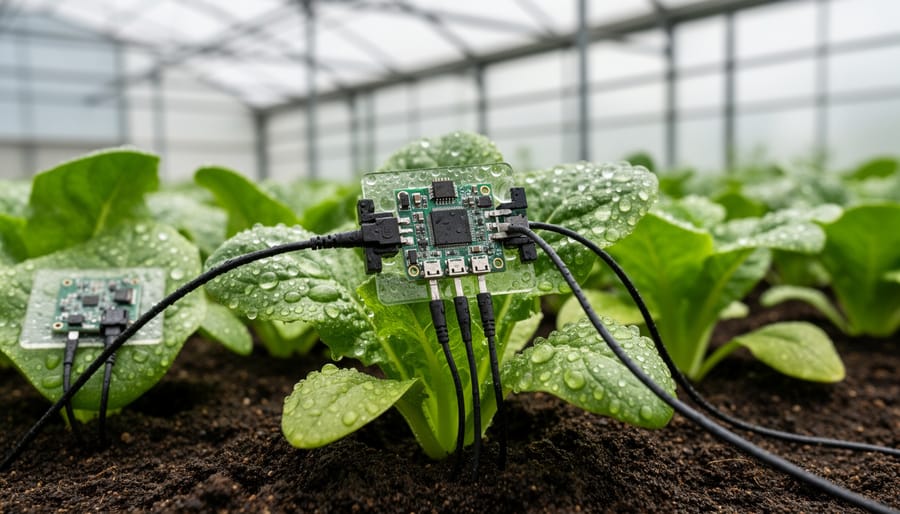
A robotic farm starts by paying attention. Before any machine moves, a network of sensors and cameras reads the growing space, much like a grower walking the rows and noticing what each crop needs.
In practice, soil sensors collect moisture readings, while other probes track temperature, light levels, and the nutrients in the water or growing medium. Cameras add a visual layer, spotting yellowing leaves, slow growth, or early signs of stress that are easy to miss by eye.
Rooftop sites can also monitor air quality, since urban air pollutants can influence how plants perform.
All of this data gives growers a clearer, more detailed picture of each crop, so decisions rest on real information rather than guesswork.
Deciding: The Software Behind the Scenes
Once the sensors have gathered their readings, the control software steps in. Think of it as the farm’s decision-maker, a program that compares what the sensors report against the targets a grower has set.
The simplest version works on plain “if this, then that” rules. If soil moisture drops below a chosen level, the irrigation controller waters for a few minutes. If the afternoon sun fades, the grow lights ramp up. These rules are easy to understand and easy to adjust.
More advanced systems add AI-assisted tools, which means software that spots patterns in past data. It might notice that lettuce on the east side of a rooftop dries out faster and suggest watering that zone a bit earlier. It can also flag a plant that looks stressed before the signs are obvious to the eye.
The grower always stays in charge. They set the goals, review the suggestions, and can override any decision. The software handles the routine checking, so the human expertise goes where it matters most.
Acting: The Machines That Do the Work
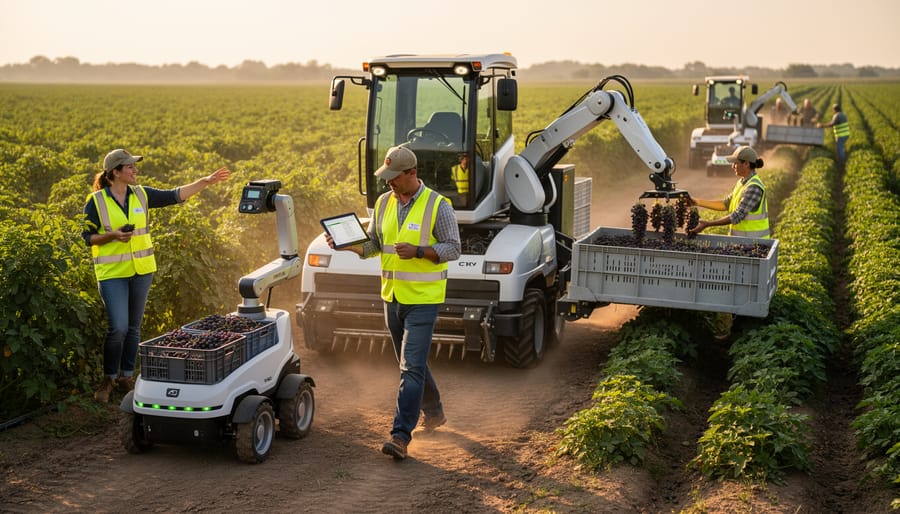
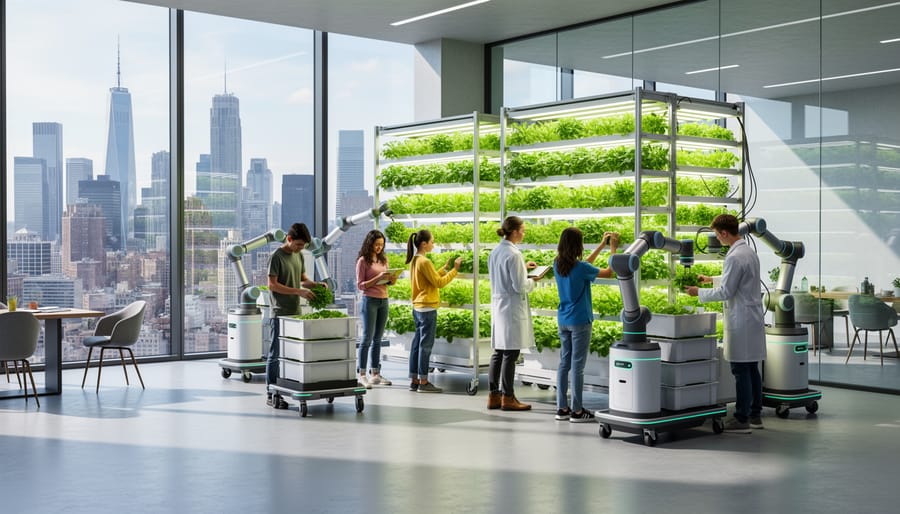
Once the farm has sensed conditions and the software has made a call, machines turn that decision into action. Robotic arms handle delicate jobs like seeding trays, transplanting seedlings, and trimming. Automated carts, sometimes called conveyors or shuttles, move trays of plants between growing zones and packing areas so no one has to haul heavy loads up stairs or across a roof.
Irrigation controllers are the quiet workhorses. They open valves and run pumps on a schedule, or in response to sensor readings, so each crop gets the right amount of water and nutrients. At harvest time, gentle gripping or cutting tools pick ripe produce without bruising it, and some crops still do best with a skilled human hand.
None of this appears by magic. Designers, engineers, and growers plan the layout together, choosing machines that fit the crops and the site. Growers know what plants need, engineers make the equipment work, and designers shape the space around both.
Types of Robotic Farming Systems and Their Key Components
Common System Types for City Sites
Cities offer very different conditions, so robotic farms come in several forms. Choosing the right one starts with what your site can actually provide.
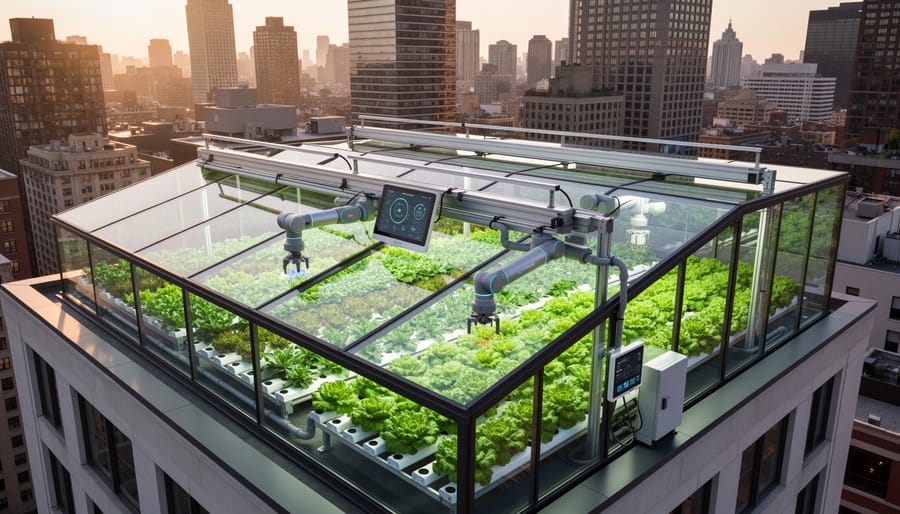
Rooftop greenhouses suit buildings with strong structural capacity and good sun exposure. Automated vents, shading, and irrigation help the greenhouse handle city weather, but you’ll need an engineer to confirm the roof can carry the added weight of soil, water, and equipment.
Indoor vertical farms stack growing trays in layers, which makes them a fit for tight footprints and spaces with little or no natural light. LED lighting replaces the sun, so reliable power matters more here than a sunny exposure. Warehouses, basements, and retrofitted commercial units are common homes for this approach.
Shipping-container farms are self-contained units that arrive ready to plug in. They work well on parking lots, vacant lots, or loading areas where you have flat ground, electricity, and water hookups but no building to grow in. They’re also movable, which helps if a site is only available for a few years.
Smaller automated units, such as countertop or wall-mounted systems, bring sensing and automatic watering to lobbies, classrooms, and restaurant kitchens. They’re a gentle first step when space or budget is limited.
If you want to see how these formats fit into the bigger picture, our look at the urban agriculture impact explains why cities are embracing them, and these urban agriculture examples show them at work in real neighborhoods.
The Core Components Inside Most Systems
Whatever shape a robotic farm takes, most of them share the same handful of building blocks. Think of them as the organs of the system, each doing one job so the whole thing keeps growing.
- Sensors: Small devices that measure moisture, temperature, light, and nutrient levels, giving the system its “eyes and ears.”
- Controllers: The brains that read sensor data and trigger the right response, like turning on a pump or dimming a light.
- Robotic arms or movers: Machines that seed, transplant, shuttle trays, or harvest so people don’t have to repeat the same motion all day.
- Automated irrigation and nutrient delivery: Pumps and valves that feed each plant the right mix of water and nutrients on a schedule.
- Grow lighting: Energy-efficient LEDs that supply the light spectrum plants need, especially indoors or in shaded spaces.
- Climate control: Fans, vents, heaters, and humidity tools that keep air conditions steady around the crop.
- Monitoring dashboards: Screens or mobile apps where growers check conditions and adjust settings from anywhere.
Not every site needs every piece. A sunny rooftop greenhouse may lean on natural light and use fewer lamps, while a windowless basement farm depends heavily on lighting and climate control. A smaller automated unit might combine just sensors, a controller, and a simple irrigation setup.
What matters is how well the parts work together. A designer or engineer who understands your building’s conditions can choose the components that fit, so you’re not paying for features you won’t use. That is the agritecture mindset in action: matching the technology to the space, rather than forcing the space to fit the technology.
How Robotic Farms Are Used in Cities Today
Robotic farms are already finding their footing in cities, and the applications are more varied than you might expect. The common thread is simple: wherever there’s a bit of space, a need for fresh food, and a team willing to plan carefully, an automated system can help make it work.
Here are some of the most practical urban use cases:
- Rooftop produce grown for local kitchens, where restaurants get herbs and greens picked hours before service.
- Community and school learning farms that let students and neighbors see how food, data, and technology connect.
- Retrofitted warehouses and parking structures that turn underused buildings into productive growing space.
- Year-round leafy greens grown close to where people live, which shortens the trip from harvest to plate.
Fresh produce for restaurants and neighborhoods is often the easiest place to start. Short supply chains mean crops reach the table quickly, and automated monitoring helps keep quality steady from one harvest to the next. Education is another strong fit. A classroom or community garden with a few sensors and an automated irrigation cart gives people a hands-on way to understand plant science, without replacing the soil-based gardening that many schools already love.
Retrofitting is where agritecture really shines. Old warehouses, empty ground-floor retail units, and flat parking decks often have the power, water access, and floor area that growing systems need. Rather than building from scratch, teams can give these spaces a second life. That same thinking supports food security, since a handful of well-placed sites can supply fresh greens to neighborhoods that have limited access to them.
None of this happens by accident. The best results come from collaboration. Architects consider structural loads, ventilation, and how the farm sits within the building. Green scientists tune light, nutrients, and crop selection. Growers bring the practical know-how that keeps plants healthy day to day. When these voices meet early in the design process, the farm feels like part of the building rather than an afterthought.
If you’re curious about the people and approaches shaping this space, it helps to explore how Z farming fits into small urban sites, and how different urban farming models turn these systems into working businesses and community projects.
Is a Robotic Farm Right for Your Space? Practical Considerations
Before you get excited about sensors and robotic arms, take a good look at the site itself. A few practical factors usually decide whether a robotic farm fits.
Space and structure. A rooftop needs enough load capacity to carry soil, water, and equipment. An engineer should confirm this early. Indoor sites need adequate ceiling height for vertical racks and room to move around them.
Energy and water. Automated systems run on electricity, and indoor setups with grow lights use more than rooftop greenhouses that borrow sunlight. Check that you have reliable power and a dependable water source. Many growers pair these systems with rainwater capture or efficient recirculating irrigation to keep demand in check.
Budget and skills. Costs vary widely with the size and complexity of the setup. Someone also needs to understand both plants and equipment, which is why training and ongoing support matter as much as the hardware.
Local rules. Zoning, building codes, and fire or safety regulations differ from city to city, so it pays to ask early.
Here’s the encouraging part: robotic tools don’t have to replace anything you already love. Many cities blend automated systems with traditional soil gardens and container beds, using each where it works best. A sunny corner might hold herbs in planters while a small automated unit handles leafy greens.
If you’re unsure, start small. A modest pilot teaches you how the system behaves on your site before you commit to more. Bringing in a multidisciplinary team of architects, engineers, and growers from the start helps you avoid surprises and shape a plan that suits your space.
Common Questions About Robotic Farms
Curious about robotic farms? Here are straight answers to the questions we hear most from city dwellers, planners, and families starting out.
Do robotic farms replace gardeners?
No. Machines take over repetitive jobs like watering schedules and routine monitoring, but people still choose the crops, read the plants, and make the calls that matter. A skilled grower makes the whole system work better.
Can a robotic farm work on a small rooftop?
Often, yes. Compact automated units, such as a small greenhouse or a modular vertical rack, can suit tight spaces. What fits depends on your roof’s load capacity, sunlight, and access to water and power, so a site assessment comes first.
Are robotic farms energy-hungry?
It varies with the setup. Indoor systems with grow lights use more electricity than a sunlit rooftop greenhouse, which can lean on natural light. Smart controls help trim waste, and planning energy use early keeps surprises low.
What can they grow, and how do they fit with traditional gardening?
Leafy greens, herbs, and many compact vegetables are common choices, though the right crops depend on your system and conditions. Robotic tools can also sit right beside soil beds and container gardens, so you can blend old and new rather than choosing one.
Every site is different, and that’s the good news. A shaded courtyard, a windy roof, and a spare basement each call for a different approach. If you’re weighing options, start with your space, your goals, and a conversation with a team that understands both plants and buildings.
Robotic farms are one more way agritecture can turn the spaces we already have into places that feed people. A quiet rooftop, a forgotten basement, or a sunny wall can become a source of fresh, local food when smart machines handle the repetitive work and growers focus on what they do best.
The real promise isn’t machines replacing the gardener. It’s technology and tradition growing side by side. Soil beds, container gardens, and green roofs still matter, and robotic tools can make them easier to tend and more productive. Add a team of designers, engineers, and growers working together, and good ideas become systems that last.
If you’re wondering what could work on your own building, school, or neighborhood site, Roof Top Gardens would love to help. Join a workshop or book a consultation, and let’s turn your feasible idea into a greener, more food-secure corner of your city.
