
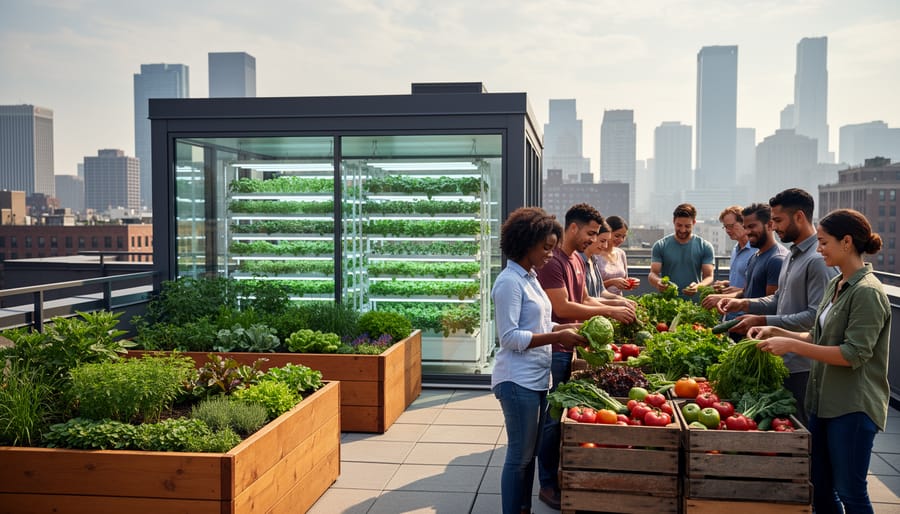
Urban farming in 2026 offers three proven entrepreneurship paths: Community-Supported Agriculture (CSA) Networks that connect hyper-local growers with subscriber bases, technology-driven Vertical Farming Ventures that produce year-round crops indoors, and Urban Farm Education and Consulting Services that transform expertise into revenue. Each model addresses critical gaps in urban food systems while creating viable businesses for different investor profiles and skill sets.
The beauty of these approaches lies in their scalability and complementary nature. You don’t need millions in capital to start. CSA networks can launch with modest infrastructure and build incrementally through member subscriptions. Vertical farms require more upfront investment but deliver faster returns through high-value crop production. Education and consulting services leverage knowledge you’ve already gained, serving the growing number of municipalities, schools, and commercial developers seeking urban agriculture guidance.
What makes these models particularly relevant now is timing. Cities worldwide are prioritizing food resilience, zoning codes are evolving to accommodate agricultural uses, and consumers increasingly value food transparency and reduced transportation miles. Our team at Rooftop Gardens has watched these trends converge over the past several years, creating genuine market opportunities rather than niche experiments.
The following breakdown examines each entrepreneurship model in practical detail: what resources you’ll need, typical revenue streams, common challenges, and who succeeds in each space. Whether you’re an experienced grower looking to monetize your operation, a tech entrepreneur eyeing controlled-environment agriculture, or an educator ready to share urban farming knowledge, one of these paths offers a starting point grounded in real-world success stories.
Why These Three Models Were Chosen
We selected these three entrepreneurship models, CSA networks, vertical farming ventures, and education/consulting services, because they meet four critical criteria that determine long-term success in urban agriculture. Each demonstrates proven scalability across different city environments, from Toronto rooftops to warehouse conversions in Detroit. They’re financially viable with clear revenue streams, whether through member subscriptions, wholesale partnerships, or service fees. Environmental sustainability runs through all three: they reduce transportation emissions, minimize water use, and mitigate urban air pollutants through green infrastructure.
Critically, these models integrate with existing city systems rather than requiring wholesale urban redesign. CSA networks use underutilized lots and rooftops. Vertical farms repurpose industrial buildings. Education services leverage parks, schools, and community centers already in place. This alignment with agritecture principles, where design meets agriculture, means entrepreneurs can launch without massive capital or regulatory battles. Each has been tested in diverse urban contexts, from dense downtowns to sprawling suburbs, proving their adaptability to your specific situation.
1. Community-Supported Agriculture (CSA) Networks: Building Local Food Economies
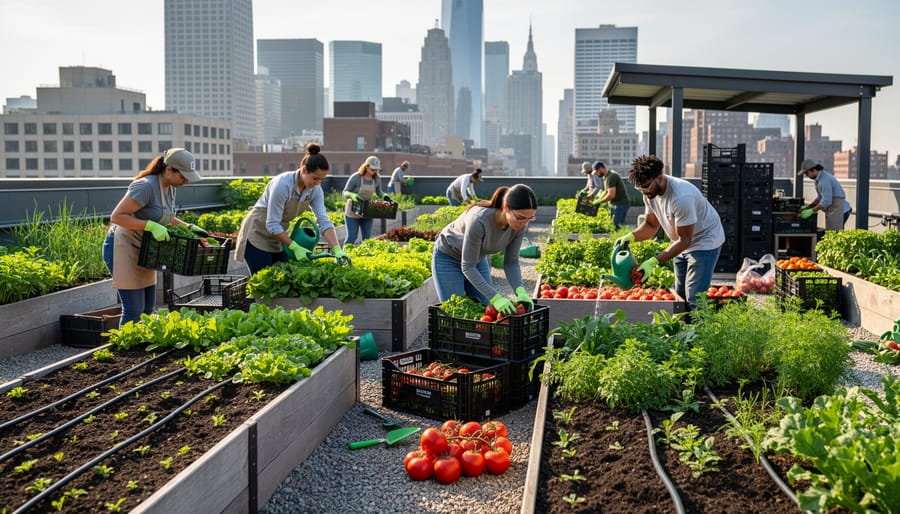
Urban CSA networks transform idle rooftops, abandoned lots, and underused green spaces into productive farms that feed their immediate neighborhoods through direct subscription relationships. An entrepreneur starts by securing a growing location, whether negotiating with property owners for rooftop access, leasing vacant land from the city, or partnering with community organizations to convert neglected parcels. Once the space is established, the farmer offers seasonal memberships where subscribers pay upfront for a share of the harvest, typically receiving a weekly box of fresh produce throughout the growing season.
This subscription model flips conventional farming economics on its head. Instead of planting crops and hoping to sell them later, urban CSA farmers secure revenue before the first seed goes in the ground. Members commit months in advance, providing the capital needed for seeds, soil amendments, and infrastructure. That financial predictability allows entrepreneurs to invest in quality inputs and plan production with confidence, knowing exactly how many people they’re feeding and what their weekly harvest needs to be.
The operational structure of an urban CSA creates natural advantages:
- Upfront membership payments fund seasonal operations without debt or outside investors
- Direct customer relationships eliminate middlemen and capture full retail value
- Compact distribution within a few city blocks cuts transportation costs to nearly zero
- Weekly member interactions build loyalty and create word-of-mouth marketing
- Rooftop and lot-based sites provide jobs accessible by public transit
- Members share production risk, understanding that weather and pests affect yields
Beyond the financial model, CSA networks create community infrastructure that conventional retail farms can’t match. Pick-up locations become neighborhood gathering points where members swap recipes, share gardening tips, and connect over shared values around local food. Some urban CSA entrepreneurs expand by hosting volunteer work days, offering member discounts on workshops, or creating tiered memberships that include flowers, herbs, or value-added products like preserves.
The model scales differently than warehouse agriculture, growth comes from replicating the neighborhood-farm-to-member relationship across multiple city sites rather than expanding a single massive facility. An entrepreneur might start with one rooftop serving fifty families, then launch a second location across town with a new member base, gradually building a network of small farms that blanket the city with hyper-local food systems while creating distributed employment opportunities in communities that need them most.
2. Vertical Farming Ventures: Tech-Enabled Production at Scale
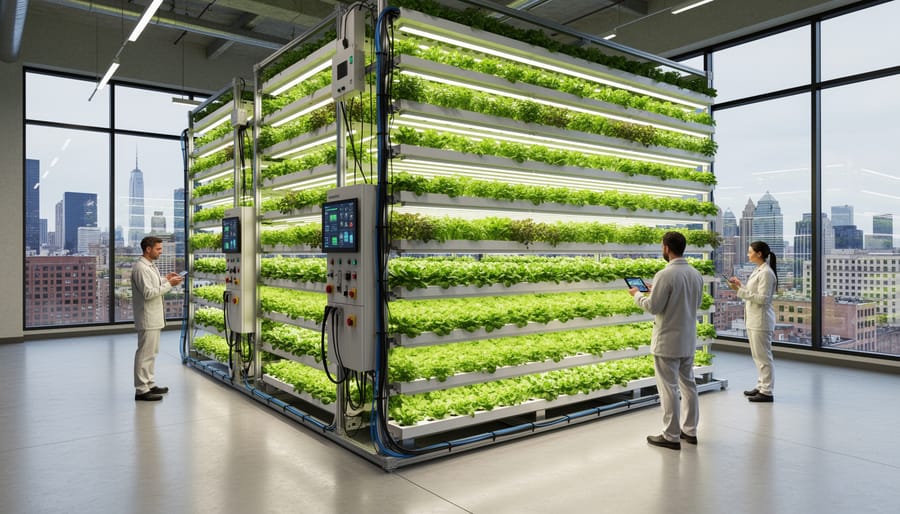
Vertical farming ventures represent the high-tech frontier of urban agriculture entrepreneurship, transforming warehouses, shipping containers, and multi-story buildings into year-round production facilities. These operations use stacked growing systems with precise environmental controls, temperature, humidity, light spectrum, and nutrient delivery, to produce crops at densities impossible in traditional farming. A 2,000-square-foot vertical farm can yield as much lettuce as five acres of conventional farmland, making it viable in expensive urban real estate markets.
The technology stack typically combines hydroponics (growing in nutrient-rich water) or aeroponics (misting roots suspended in air) with full-spectrum LED lighting calibrated to specific crop requirements. Entrepreneurs can grow leafy greens, herbs, microgreens, and strawberries with 90% less water than soil-based methods while eliminating pesticides entirely. Climate control systems maintain optimal conditions regardless of outside weather, enabling consistent harvests every few weeks rather than seasonal cycles.
Capital requirements present the biggest barrier to entry. A modest shipping-container setup might start around $100,000, while a purpose-built warehouse facility can require $500,000 or more for HVAC systems, grow racks, LED arrays, irrigation automation, and backup power. However, this investment buys production certainty, no crop failures from drought, frost, or pests, and output quality that commands premium prices from chefs valuing same-day harvest freshness.
Successful vertical farming entrepreneurs build strategic partnerships before breaking ground. Direct relationships with high-end restaurants guarantee purchase commitments for specialty greens and herbs. Grocery chains increasingly dedicate shelf space to hyper-local brands. Corporate campuses and universities contract for cafeteria supplies. These partnerships provide revenue predictability that justifies the capital outlay and help secure financing.
The complexity of vertical farming demands multidisciplinary collaboration. Architects design energy-efficient building envelopes and optimize spatial layouts for workflow and equipment access. Green science experts specify irrigation systems, nutrient formulations, and pest management protocols. Automation specialists program lighting schedules and climate controls. This professional team approach, central to agritecture thinking, transforms technical challenges into competitive advantages through integrated design that maximizes both yield and operational efficiency.
3. Urban Farm Education and Consulting Services: Knowledge as Product

Urban farming expertise becomes a product when entrepreneurs package their knowledge into workshops, consulting engagements, and design services. This model suits professionals who’ve built substantial experience in urban agriculture and can translate that knowledge into educational offerings for clients ranging from homeowners wanting rooftop gardens to corporations seeking green infrastructure. Unlike production-based models that depend on harvests, the education and consulting approach generates revenue through intellectual capital and service delivery.
The business starts with identifying target markets and developing structured offerings. Homeowners and community groups typically seek basic workshops on container gardening, composting, and seasonal planting strategies. Schools need curriculum-integrated programs that teach students about food systems while creating functional garden spaces on campus. Businesses and property developers want sophisticated consultations on incorporating productive landscapes into commercial buildings, often requiring collaboration between horticulturists, architects, and sustainability planners. Municipalities commission feasibility studies, pilot programs, and community engagement initiatives for larger urban agriculture projects.
Revenue streams multiply as entrepreneurs expand their service portfolio:
- One-time workshops and multi-session courses on specific techniques or crops
- Custom garden design and installation for residential and commercial spaces
- Ongoing maintenance contracts providing seasonal care and harvesting support
- Technical consulting for vertical farm startups and food business ventures
- Corporate training programs connecting employee wellness to urban agriculture
- Digital courses and online resources reaching clients beyond geographic limits
The strongest consulting businesses leverage diverse professional backgrounds to deliver comprehensive solutions. An entrepreneur with architecture training designs structurally sound rooftop gardens that meet building codes. Someone from digital media creates engaging educational content and manages online course platforms. Horticulture experts develop planting schedules and pest management protocols. This multidisciplinary approach allows consultants to address complex client needs rather than offering only basic gardening advice.
Successful education-focused entrepreneurs build credibility through demonstration sites, their own productive gardens serving as living portfolios that showcase techniques and results. They establish relationships with nurseries, equipment suppliers, and construction firms to streamline installations. Some formalize their offerings through certification programs, creating recurring revenue as participants advance through skill levels. The model scales efficiently because knowledge transfers to many clients without inventory constraints, though maintaining quality requires balancing client load with personalized attention that justifies premium pricing.
Making Your Choice: Which Model Fits Your Urban Context
Your choice hinges on three core factors: what you have, what you can invest, and what your community needs.
Start with space. Rooftops and vacant lots suit CSA networks beautifully. You need enough area to grow diverse crops that justify subscription boxes, typically 1,000 square feet minimum for a viable member base. Warehouses and industrial buildings align with vertical farming ventures, where controlled environments maximize production per square foot. Even a 2,000-square-foot space can yield significant volume when you stack growing systems. Balconies, courtyards, and smaller plots work best for education and consulting services, where you demonstrate techniques rather than produce at commercial scale.
Capital requirements vary dramatically. CSA networks need moderate startup funds, soil, seeds, basic irrigation, fencing, often $5,000 to $20,000 depending on land preparation. Vertical farming demands substantial investment in climate control, LED systems, and hydroponic infrastructure, frequently $100,000 or more. Education services require the least capital but the most expertise; your knowledge is the product.
Match your skills honestly. CSA networks reward horticultural knowledge and community organizing. Vertical farming requires technical competence in controlled-environment systems and supply chain management. Consulting services demand teaching ability and design skills across multiple examples of urban agriculture.
Test before you commit. Run a pilot season with ten CSA members. Build a small vertical prototype before leasing warehouse space. Offer three workshops before launching a full curriculum.
The best urban farming entrepreneurs understand both plants and cities. They know zoning codes, building relationships with property owners, and navigating health regulations. Your model should fit not just your resources but your city’s infrastructure, culture, and appetite for local food. Start with what you can manage today, then scale as you learn what your urban context truly needs.
Common Questions About Urban Farming Entrepreneurship
Starting an urban farming business raises immediate practical questions. Here’s what entrepreneurs typically want to know before launching their ventures.
How much capital do I need to start an urban farming business?
CSA networks can launch with $5,000-$15,000 for initial equipment, seeds, and infrastructure on existing space. Vertical farming ventures typically require $100,000-$500,000 for controlled-environment systems and technology. Education and consulting services often start with under $3,000 for marketing materials and basic tools.
What permits and regulations do I need to navigate?
Requirements vary by city but typically include zoning approval for agricultural use, business licenses, and food handling permits if selling produce directly. Some municipalities have streamlined processes for urban agriculture, while others still categorize it under industrial or commercial codes. Contact your local planning department early, as approval timelines range from weeks to several months.
How long until an urban farming business becomes profitable?
Consulting services can generate revenue within the first month through workshop fees and design contracts. CSA operations typically break even in their second or third season once member networks stabilize. Vertical farming ventures often require two to four years to reach profitability due to higher initial capital costs and learning curves with technology systems.
How much space do I actually need to start?
A viable CSA operation can begin on as little as 2,000 square feet of rooftop or vacant lot space. The Z farming model demonstrates how vertical approaches maximize small footprints. Consulting businesses need no dedicated growing space beyond demonstration gardens.
Customer acquisition strategies matter as much as production capabilities. For CSA networks, start with neighborhood outreach through community boards, farmers markets, and local social media groups where urban residents already discuss sustainable living. Vertical farming ventures benefit from direct partnerships with restaurants and grocery stores seeking consistent local supply, approach chefs and buyers with samples before full production launches. Education services grow through word-of-mouth and portfolio building, so offer initial workshops at reduced rates to schools or community centers to establish credibility and generate referrals.
These three entrepreneurship models, CSA networks, vertical farming ventures, and education services, offer proven pathways into urban agriculture that match different skills, capital levels, and community needs. You don’t need a massive warehouse or advanced technology to start. A rooftop CSA can begin with a handful of members, a consultation service can launch from expertise you already possess, and vertical systems can scale from a single prototype unit.
The beauty of urban farming entrepreneurship lies in its flexibility. Your background in architecture, digital media, community organizing, or green sciences becomes an asset rather than a barrier. Cities need food solutions that work within their unique constraints, limited space, diverse populations, existing infrastructure, and these models adapt to those realities instead of fighting them.
As urban populations grow and climate pressures increase, entrepreneurial innovation in agriculture becomes essential infrastructure, not a lifestyle trend. You’re not just building a business; you’re creating food security, reducing environmental impact, and strengthening the fabric of city life. Whether you start with a small rooftop plot, invest in controlled-environment technology, or share knowledge through workshops, you’re contributing to resilient urban systems that feed people while respecting ecological limits. The question isn’t whether cities need these solutions, it’s which model matches your vision and context best.
