
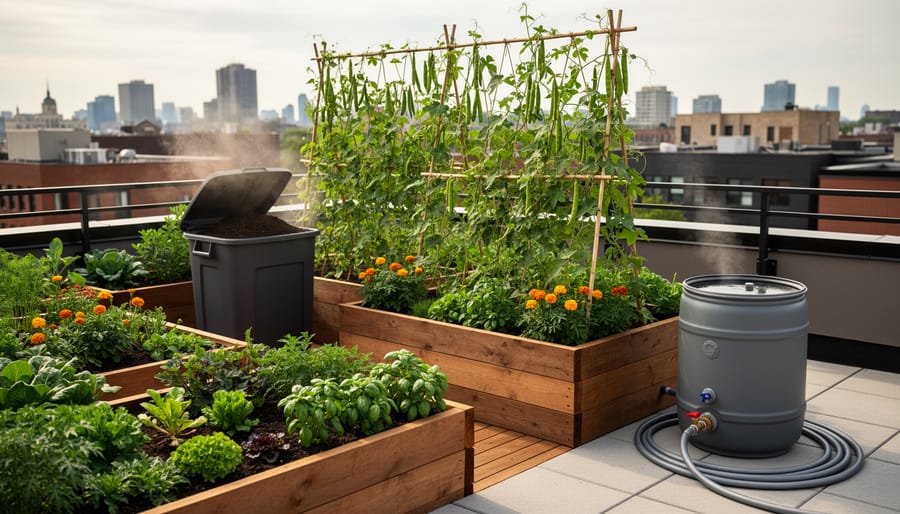
Permaculture farming is a design system that works with nature to create self-sustaining food production spaces, turning even the smallest rooftop or balcony into a productive ecosystem that requires less water, fertilizer, and maintenance than conventional gardens. The approach relies on three core principles: care for the earth, care for people, and fair share of surplus. These translate into practical techniques like stacking plants vertically to maximize space, capturing rainwater where it falls, and choosing species that support each other rather than compete.
For urban growers, permaculture offers a way out of the constant cycle of buying inputs and fighting pests. Instead of treating your rooftop garden as a collection of separate containers, you design it as a connected system where each element serves multiple functions. A trellis doesn’t just support climbing beans; it provides afternoon shade for heat-sensitive lettuce below. Compost bins don’t just break down kitchen scraps; they generate warmth that extends your growing season and attract beneficial insects.
The practice has gained serious momentum among city dwellers who’ve seen other urban agriculture examples and want something more resilient than traditional row planting. Unlike conventional methods that depend on constant intervention, permaculture systems become easier to manage over time as plants establish relationships and soil life builds. Your second season requires less work than your first. Your third season even less.
This shift matters because urban growing spaces face unique constraints: weight limits, wind exposure, limited soil depth, and irregular watering access. Permaculture addresses these challenges through thoughtful design rather than brute force, creating gardens that adapt to city conditions instead of fighting them. The result is food production that actually fits into busy urban lives.
What Permaculture Farming Actually Means for City Dwellers
Permaculture farming is a design approach that mimics natural ecosystems to create productive, self-sustaining food systems, and it works just as effectively on a balcony as it does on a rural plot. Instead of fighting against nature with constant inputs and maintenance, permaculture works with natural patterns to build systems that become more resilient over time. For city dwellers, this means growing food in ways that actually reduce work while improving soil health, conserving water, and supporting urban biodiversity.
At its heart, permaculture rests on three core ethics that guide every decision. Earth Care means designing systems that regenerate soil, conserve resources, and create habitat rather than depleting them. People Care ensures your urban garden meets real human needs, whether that’s fresh herbs outside your kitchen or a productive green space shared with neighbours. Fair Share acknowledges that resources are finite; in urban contexts, this might mean sharing surplus tomatoes, composting food waste to close nutrient loops, or designing gardens that don’t monopolize shared rooftop access.
These ethics translate into practical principles that shape why urban gardening through a permaculture lens looks different from conventional approaches. Here’s what some key concepts mean in city spaces:
- Observe and Interact
- Spend time noticing how sun moves across your balcony, where wind hits hardest, and which corners stay damp, then design around these patterns instead of imposing a predetermined layout.
- Catch and Store Energy
- In urban permaculture, this means capturing rainwater in containers, collecting autumn leaves for compost, or positioning dark pots to absorb and radiate warmth for heat-loving plants.
- Obtain a Yield
- Your system must produce something useful, whether edible crops, medicinal herbs, or flowers that support pollinators, permaculture rejects purely ornamental designs that don’t contribute to the ecosystem.
- Use Small, Slow Solutions
- Start with a few containers and proven techniques rather than overhauling your entire rooftop at once, allowing you to learn what works in your specific microclimate before expanding.
- Use Edges and Value Diversity
- The transition zones, where railing meets rooftop, or where a trellis creates shifting shade, often support the most productive plantings when you stack different species with complementary needs.
What makes permaculture particularly relevant for urban food systems in 2026 is its emphasis on working within constraints. Limited space isn’t a barrier; it’s a design parameter that encourages creative stacking of functions and careful selection of perennials that deliver year after year. The goal isn’t to replicate a country farm on your roof, it’s to create a thriving, low-maintenance ecosystem that fits seamlessly into city life while contributing to a more sustainable food system.
From Theory to Rooftop: How Permaculture Principles Work in Urban Agritecture
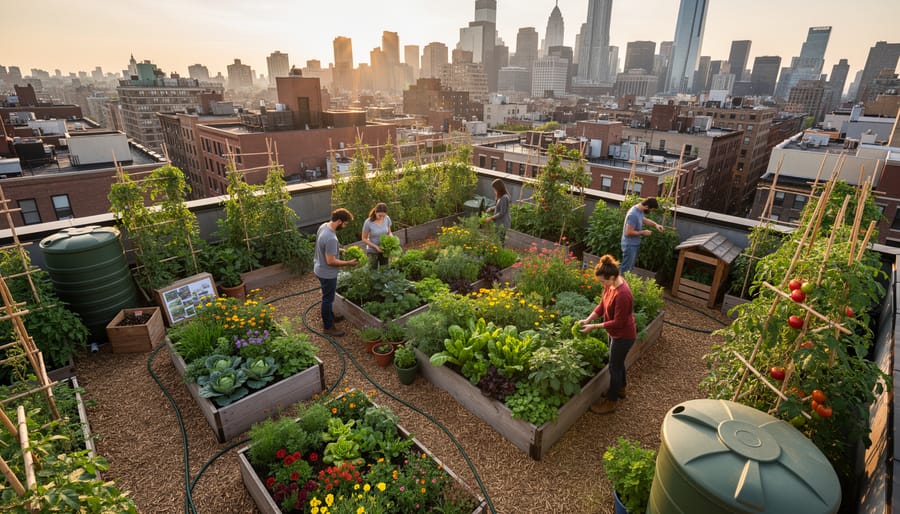
Zone Planning for Small Urban Spaces
Traditional permaculture divides a property into five zones based on how often you visit each area, zone zero being your home, zone one the kitchen garden, zone five the wild forest. In a city apartment or small rooftop, you might have just fifteen feet of balcony railing or a hundred square feet of terrace. The same logic still applies.
Place your most demanding plants where you naturally pass several times a day. That means culinary herbs like basil, cilantro, and chives go right outside your kitchen door or on the windowsill you lean past while washing dishes. These need frequent harvesting, regular watering, and quick pest checks. Positioning them in your highest-traffic zone makes daily care effortless rather than a chore you forget.
Your zone two might be the far corner of a balcony or the edge of a rooftop bed you visit weekly to water and weed. Here, plant salad greens, compact tomatoes, or peppers that need attention but not constant fussing. Zone three, if you have the space, holds hardier perennials: a strawberry tower, perennial kale, or self-seeding arugula that you check monthly and harvest occasionally.
This zoning prevents burnout. When high-maintenance plants live where you already walk, caring for them becomes automatic. When low-maintenance perennials occupy the edges, they thrive on benign neglect. Urban growers who fight this logic, putting fragile microgreens in a hard-to-reach corner, end up with dead plants and frustration. Work with your natural movement patterns, and your urban permaculture system practically tends itself.
Stacking Functions in Vertical Gardens
In a vertical garden, stacking functions transforms every plant and structure into a multi-tasking workhorse. A climbing bean trellis doesn’t just support vines, it casts afternoon shade over heat-sensitive lettuce below, creates a cooler microclimate that reduces evaporation, and provides privacy screening from neighboring buildings. The beans themselves fix nitrogen in the soil while producing food, turning one vertical square meter into a climate regulator, nutrient factory, and food source simultaneously.
Consider pole beans interplanted with climbing nasturtiums on a shared trellis. The beans enrich the soil, the nasturtiums attract pollinators and repel aphids, and both provide edible harvests while the trellis structure doubles as a windbreak for tender herbs planted at its base. That’s five functions from two plant species and one structure.
Perennial vines like hardy kiwi or passionfruit serve particularly well in compact spaces. They create dense canopy cover that moderates rooftop temperature extremes, their root systems stabilize growing media against wind erosion, and their foliage transpires moisture that humidifies the surrounding air, reducing water needs for neighboring plants. Meanwhile, they’re producing fruit.
The key is asking what else each element can do. A water tank doesn’t just store rainwater; position it strategically and it becomes thermal mass that moderates temperature swings. Attach a trellis to its sunny side and you’ve added vertical growing space. Stack functions deliberately and your urban garden works harder without requiring more space, water, or your time.
Building Healthy Urban Soil: The Permaculture Foundation
Healthy soil is the foundation of permaculture farming, but urban growers face a unique challenge: they’re often working with containers, raised beds, or engineered rooftop substrates rather than the ground itself. Traditional permaculture texts emphasize letting nature build soil over time, yet city dwellers can’t always wait years for decomposition cycles to create the rich, living ecosystem their plants need. The good news is that permaculture’s core principles, observation, diversity, and cyclical thinking, translate beautifully to accelerated soil-building techniques designed for constrained urban spaces.
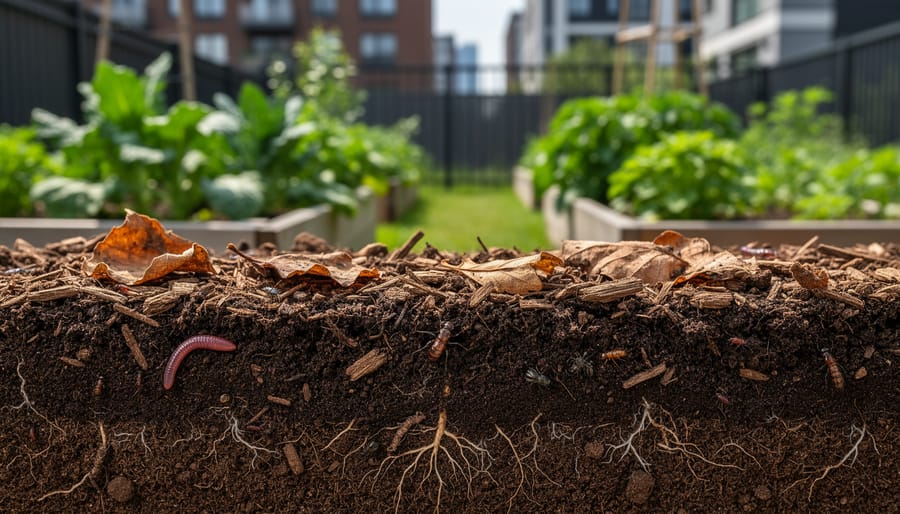
Start with composting, the most accessible entry point into regenerative soil practices. Even a small balcony can accommodate a worm bin or compact tumbler that transforms kitchen scraps into nutrient-dense amendments. Vermicompost introduces beneficial microorganisms while improving soil structure, and unlike synthetic fertilizers, it releases nutrients slowly as plants actually need them. For rooftop installations, many growers partner with professional teams to integrate larger-scale composting systems that handle green waste from the building or neighbourhood, creating closed-loop fertility cycles that reduce both waste exports and input costs.
Mulching serves multiple functions in urban permaculture systems, making it one of the most efficient urban gardening strategies available. A 5-8cm layer of organic material, shredded leaves, straw, wood chips, or even cardboard, suppresses weeds, regulates soil temperature in exposed rooftop conditions, and gradually breaks down to feed soil organisms. In containers where evaporation happens rapidly, mulch can cut watering needs by half while preventing that hard, crusty surface layer that blocks water infiltration. Choose materials wisely: fine compost mulches work well for annual vegetables but can compact in heavy rain, while coarser wood chips suit perennial plantings and pathways where slower decomposition is acceptable.
Building a living soil ecosystem means thinking beyond NPK ratios to cultivate the entire food web, bacteria, fungi, protozoa, and microarthropods that cycle nutrients and protect plant roots. Introduce diversity through cover cropping between seasons, even in containers: a quick-growing mix of clover, vetch, and mustard adds nitrogen, breaks up compaction with different root structures, and feeds soil life when chopped and dropped as green mulch. Mycorrhizal fungi inoculants, available at most garden centres, establish symbiotic relationships that extend root systems and improve drought tolerance, particularly valuable in the harsh conditions of rooftop microclimates where containers dry quickly and temperature swings stress plants.
The permaculture principle of “no waste” means every output becomes an input. Coffee grounds, crushed eggshells, and even hair clippings contribute trace minerals as they decompose. Finished plant material gets chopped and layered back into beds rather than discarded, creating that continuous cycling of organic matter that characterizes healthy ecosystems. This approach reduces the need for purchased amendments while building soil structure and carbon content season after season, transforming sterile potting mix into a self-sustaining system that actually improves with age.
Water-Wise Strategies That Make Urban Permaculture Practical
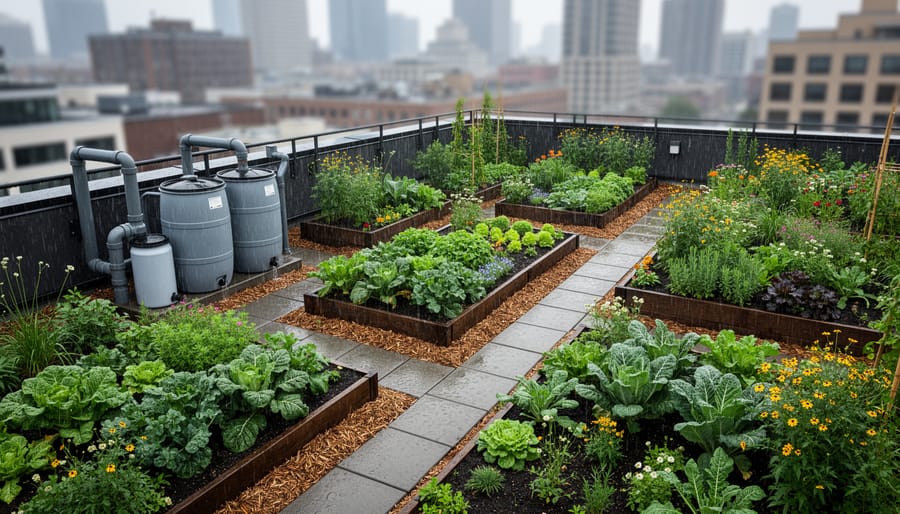
Water sits at the heart of successful urban permaculture. City growers face a paradox: rooftops and balconies dry out faster than ground-level gardens, yet managing runoff and drainage in built environments requires careful planning. The good news? Permaculture’s water-wise strategies transform these challenges into opportunities for resilient, low-maintenance systems.
Start with rainwater harvesting, the most accessible water strategy for urban spaces. Even a modest rooftop can capture thousands of gallons annually. Simple barrel systems collect runoff from gutters, providing chlorine-free water that plants prefer over municipal supplies. Professional teams often integrate cisterns into rooftop designs, tucking storage beneath growing beds or along building edges. This stored water becomes your buffer during dry spells, reducing reliance on city water and lowering utility costs.
Swales, shallow channels that slow and infiltrate water, adapt surprisingly well to rooftop contexts. Rather than the large earthworks you’d see on rural land, urban swales might be subtly graded sections of a growing bed or channels between raised planters that direct water toward thirsty perennials. The principle remains: slow it, spread it, sink it. Water moves across your space deliberately rather than rushing to drains.
Greywater systems take water conservation further by repurposing sink, shower, and laundry water for irrigation. Check local codes first, as regulations vary widely. When permitted, a basic water filtration system removes soap and particles before the water reaches your plants. Greywater works best for ornamental perennials and fruit trees rather than vegetables you’ll eat raw.
Mulching might be the simplest retention strategy, yet urban growers often skip it. A three-inch layer of wood chips, straw, or compost dramatically reduces evaporation while feeding soil organisms. Combine mulch with shade-casting companion plants, and your containers hold moisture days longer between waterings.
Integrate these strategies and you’re not just conserving water, you’re building a system that practically runs itself. One rooftop grower in Toronto hasn’t hand-watered her established permaculture beds in two years, relying entirely on rain capture and mulch retention. That’s the shift from high-input gardening to genuinely sustainable urban food production.
Choosing Plants for Urban Permaculture Systems
Plant selection in urban permaculture goes far beyond picking what looks good at the nursery. You’re choosing the living infrastructure of your system, and the right plants will quietly work for you year after year while the wrong ones demand constant attention and replacement.
Start with perennials that actually earn their space. In contained urban environments, every pot and planter needs to justify itself. Perennial vegetables like walking onions, sorrel, and Good King Henry come back season after season without replanting. Egyptian walking onions self-propagate through top bulbs, giving you both greens and bulbs while requiring almost no maintenance once established. Sorrel delivers tangy leaves from early spring through fall and tolerates partial shade common on urban rooftops.
| Plant Type | Growing Zones | Container Suitability | Primary Functions |
|---|---|---|---|
| Perennial kale | 4-9 | High (18″ depth) | Food, pollinator support, year-round greens |
| Chives | 3-10 | High (8″ depth) | Food, pest deterrent, edible flowers |
| Thyme | 5-9 | Excellent (6″ depth) | Ground cover, pollinator habitat, culinary herb |
| Strawberries (alpine) | 3-10 | Excellent (8″ depth) | Fruit, ground cover, cascading edge planting |
| Lovage | 3-8 | Moderate (20″ depth) | Food, beneficial insect attractor, tall element |
Herbs form the backbone of most urban permaculture systems because they stack functions beautifully. Rosemary and sage grow woody enough to provide structure while offering culinary value and year-round foliage. Oregano and thyme spread to fill gaps and suppress weeds while feeding pollinators and requiring zero irrigation once their roots establish. Mint, contained properly, creates dense growth that cools soil and deters certain pests.
Think vertically and in layers. Pole beans climbing over a trellis fix nitrogen while creating shade for heat-sensitive greens below. Nasturtiums cascade over container edges as living mulch, their peppery leaves edible and their flowers pulling aphids away from other plants. This layering mimics forest ecosystems in miniature.
Companion planting matters more in tight urban spaces. Pair tomatoes with basil not because of folklore but because basil’s dense foliage shades soil and reduces water loss while its scent may confuse pests. Plant carrots near alliums; their different root depths and nutrient needs mean they don’t compete. Marigolds aren’t magic pest repellents, but their roots do release compounds that suppress certain soil nematodes.
Choose varieties bred for containers when possible. Dwarf fruit trees on rootstock like M27 or M9 stay manageable in large pots while still producing. Bush varieties of beans and peas need less support structure than vining types. Determinate tomatoes stay compact compared to sprawling indeterminate varieties.
Native plants and those adapted to your specific climate will always outperform exotic choices. They’ve evolved with local insects, require less coddling through temperature swings, and support the biodiversity that makes permaculture systems resilient. A professional team familiar with your region’s microclimates can identify which perennials will genuinely thrive on your particular rooftop or balcony rather than merely survive.
Learning Permaculture: Training Opportunities in 2026
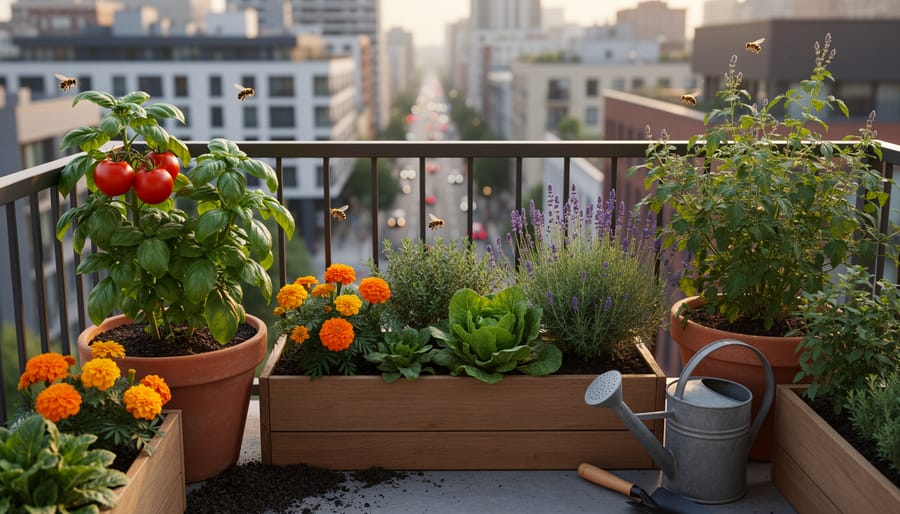
Getting started with permaculture doesn’t require moving to a rural homestead. In 2026, training options have expanded significantly to meet urban gardeners where they are, with formats ranging from intensive weekend workshops to extended online programs.
For those who prefer learning from home, online courses offer flexibility without sacrificing depth. A nine-week online program running from June 30 through August 25 this summer provides comprehensive permaculture design training that fits around work schedules. These longer formats let you apply concepts to your own urban space in real time, testing ideas on your balcony or rooftop as you learn.
In-person workshops create opportunities to practice hands-on techniques and connect with local permaculture communities. This summer’s programming in Saskatchewan runs from June 3 through August 25, with sessions based in Saskatoon that let participants see permaculture principles applied in northern climates similar to many Canadian cities. The concentrated format at 2626 Dewdney Ave E in Regina offers another accessible option for prairie-region growers looking to translate permaculture to short growing seasons.
For those seeking immersion in tropical permaculture systems, a course scheduled for October 4 through 18 in Puerto Viejo de Talamanca, Costa Rica, demonstrates how these principles adapt to radically different growing conditions. Seeing permaculture work across climate zones deepens understanding of its fundamental adaptability.
When evaluating training programs, look for courses that include design exercises specific to urban constraints, not just theory developed for large rural properties. The best urban-focused programs address weight loads, container systems, and vertical growing strategies alongside traditional permaculture techniques. Many also connect students with local networks of practitioners who collaborate on city-specific challenges.
Starting with a short workshop or introductory online module lets you test whether permaculture’s whole-systems approach resonates with your gardening goals before committing to certification programs.
Common Challenges (And How Urban Growers Solve Them)
Urban permaculture practitioners regularly encounter four major obstacles: structural weight limits on rooftops and balconies, local building codes that restrict green installations, limited square footage that seems incompatible with food forests, and the upfront investment required for proper infrastructure. These challenges are real, but experienced growers have developed practical workarounds that make permaculture farming viable even in dense city environments.
Weight restrictions present the most immediate concern for rooftop projects. A saturated soil bed can exceed 150 pounds per square foot, well beyond what many residential buildings support. The solution lies in lightweight growing media, blends of coconut coir, perlite, and compost that retain moisture while weighing 40-60% less than traditional soil. Collaborating with structural engineers during the planning phase helps you avoid green roof failures by ensuring your permaculture design respects load-bearing capacities from the start. Professional teams often position heavier elements like water barrels and deep planters over load-bearing walls and columns, distributing weight strategically rather than uniformly.
Building codes vary dramatically between municipalities, with some cities requiring permits for anything that alters roof drainage or adds permanent structures. The workaround many growers use is modular, movable containers that don’t trigger permit requirements while still supporting perennial plantings and vertical systems. Establishing relationships with city planners early in your design process often reveals allowances for green infrastructure that aren’t immediately obvious in written regulations.
Pros
- Dramatically reduces water needs once systems mature, cutting maintenance time and costs.
- Creates resilient ecosystems that recover quickly from pest pressure or weather stress.
- Produces food year-round with properly selected perennials and succession planting.
- Improves building insulation and air quality while growing food.
Cons
- Requires 2-3 years for perennial systems to reach full productivity.
- Initial setup costs run higher than conventional container gardens.
- Demands careful structural assessment to prevent building damage.
- Limited plant diversity compared to ground-level permaculture sites.
Initial costs intimidate many would-be practitioners, since quality containers, irrigation components, and soil amendments add up quickly. Smart growers phase their installations, starting with a small zone that generates quick returns, herbs and salad greens, while gradually expanding into perennial fruit and nitrogen-fixers as budget allows. Salvaged materials like food-grade IBC totes and reclaimed wood dramatically cut expenses without compromising function. Many urban permaculture groups also operate tool libraries and bulk-buying cooperatives that make professional-grade equipment accessible without individual purchase.
The space constraint actually becomes an advantage once you shift perspective. Compact urban sites force the intensive observation and creative stacking that defines good permaculture design, often resulting in higher per-square-foot productivity than sprawling suburban plots where functions spread too thin.
The rooftops, balconies, and neglected corners of our cities hold more potential than most people realize. Permaculture farming isn’t just another gardening trend, it’s a practical framework for transforming these underused spaces into productive ecosystems that feed people, support biodiversity, and regenerate the environment. When urban dwellers apply permaculture principles to their immediate surroundings, they become active participants in reimagining how cities produce food.
You don’t need a rural property or a design certification to begin. Start with one container garden that captures rainwater, or a small herb spiral near your kitchen door. Observe how sunlight moves across your balcony. Notice where water pools after rain. These simple acts of attention are the foundation of permaculture design, and they work just as well on a fire escape as they do on farmland.
For larger projects, rooftop installations, community gardens, or building-integrated systems, collaboration with professionals who understand both green architecture and permaculture principles makes the difference between a struggling experiment and a thriving system. The intersection of agritecture and permaculture thinking is where urban food systems genuinely shift from industrial dependency toward local resilience.
Your urban space, however small, is an opportunity. The question isn’t whether permaculture farming belongs in cities. It’s how quickly we’ll recognize that our built environment needs these living systems to function sustainably in 2026 and beyond.
